 Ondo
Ondo OUSG: Fund Access, Minimums, and Redemption Terms
Ondo OUSG gives approved accredited investors who are also qualified purchasers tokenized exposure to short-term U.S. Treasuries and money market funds. The instant route operates 24/7, with a $5 000 transaction minimum and capacity and liquidity limits. Standard non-instant subscriptions require $100 000, while non-instant redemptions require $50 000. The token records a limited partnership interest in Ondo I LP. Access depends on fund onboarding, and redemption timing depends on the selected transaction method.
Updated -In short: Instant OUSG redemption depends on remaining global capacity, your remaining investor allowance, and available liquidity in the selected route's settlement stablecoin.
Accredited status and qualified purchaser access
OUSG access requires two investor classifications: accredited investor and qualified purchaser. You must satisfy at least one criterion under each classification, and jurisdiction restrictions also apply. The fund verifies the accredited investor evidence that you submit. You self-attest to the qualified purchaser criterion that you meet. An individual can meet one qualified purchaser test by owning at least $5 million in investments. Accredited investor status has different tests; meeting one requirement doesn't automatically satisfy the other. USDY follows a separate note structure and eligibility policy.
Onboarding to the Qualified-Access Funds starts with know-your-customer (KYC) review and sanctions screening. After KYC approval, applicants provide their wallet addresses, then review and sign the fund documents.
Fund approval covers subscriptions, redemptions, and transfers, including receiving OUSG from another holder. Connecting a wallet doesn't establish the holder's eligibility or grant fund approval.
Subscription, redemption, and collateral options
OUSG subscriptions add a fund interest, redemptions exchange that interest for proceeds, and transfers move it to another approved holder. Borrowing through Flux Finance adds a debt obligation while using OUSG as collateral. These operations have different prerequisites even when each concerns the same token.
| OUSG operation | Minimum or financial effect | Required access or capacity |
|---|---|---|
| Instant subscription | $5 000 minimum | Fund approval and remaining mint capacity |
| Non-instant subscription | $100 000 minimum | Fund approval; supported stablecoins or a USD wire |
| Instant redemption | $5 000 minimum | Fund approval, remaining redemption capacity, and liquidity in the selected route's settlement stablecoin |
| Non-instant redemption | Standard $50 000 minimum | Fund approval and OUSG tokens to redeem |
| Transfer to another holder | Moves the fund interest | Both parties onboarded to Qualified-Access Funds |
| Borrowing against OUSG through Flux | Creates stablecoin debt | OUSG permissions and sufficient collateral under Flux rules |
| Transaction minimums describe dollar values, not minimum counts of OUSG tokens. | ||
Instant execution and shared capacity
OUSG's instant mints with USDC or PayPal USD (PYUSD) and its instant redemptions to USDC are atomic: the asset exchange succeeds or fails as a whole. A successful instant mint returns OUSG to the same wallet that supplies the stablecoins. An instant USDC redemption returns USDC in the same transaction that accepts OUSG. Instant redemptions are also available in PYUSD. The XRP Ledger deployment supports subscriptions and redemptions with Ripple's RLUSD. Instant minting and instant redemption each have a $50 million global limit within 24 hours. Each also has a $25 million limit per investor within 24 hours. Both limits reset every 24 hours. The smaller remaining global or individual allowance determines the maximum available transaction.
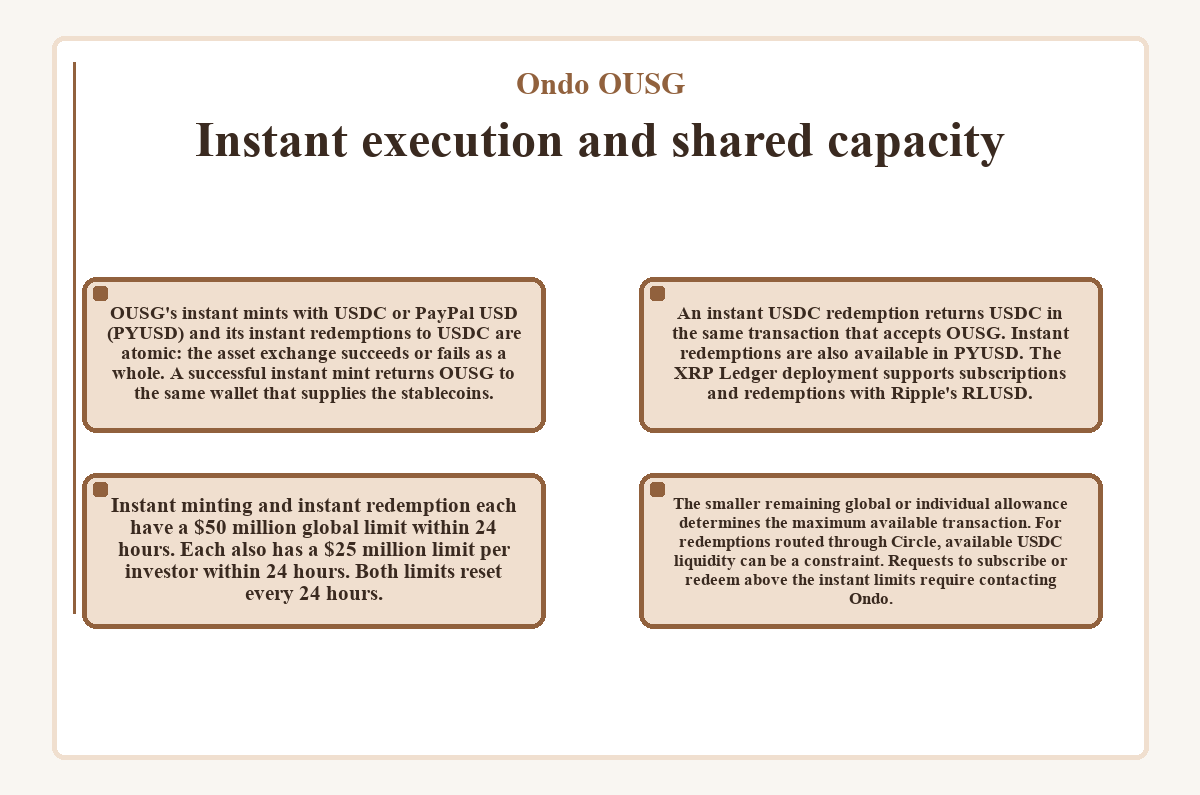
For redemptions routed through Circle, available USDC liquidity can be a constraint. Requests to subscribe or redeem above the instant limits require contacting Ondo.
Business-day settlement and the daily cutoff
Non-instant OUSG redemptions typically return proceeds the next business day when investors submit tokens before 4 p.m. Eastern Time (ET). After the cutoff, the fund usually processes the redemption on the following business day. Proceeds then typically arrive on the business day after processing. Weekends and holidays can extend the calendar time between submission and payment.
Non-instant subscriptions use the same cutoff but measure when the fund receives the money. Receipts before 4 p.m. ET typically lead to OUSG issuance the next business day. Later receipts typically lead to issuance on the business day after the next. Initiating a bank wire doesn't establish when the fund receives its proceeds.
Management fees, fund expenses, and net returns
OUSG's management fee and fund expenses are separate costs. The management fee is capped at 0.15% and waived until January 1, 2027. Fund expenses remain separately capped at 0.15% per annum. The instant minting and redemption product fee is currently 0%. That transaction fee doesn't remove the fund's ongoing expenses.
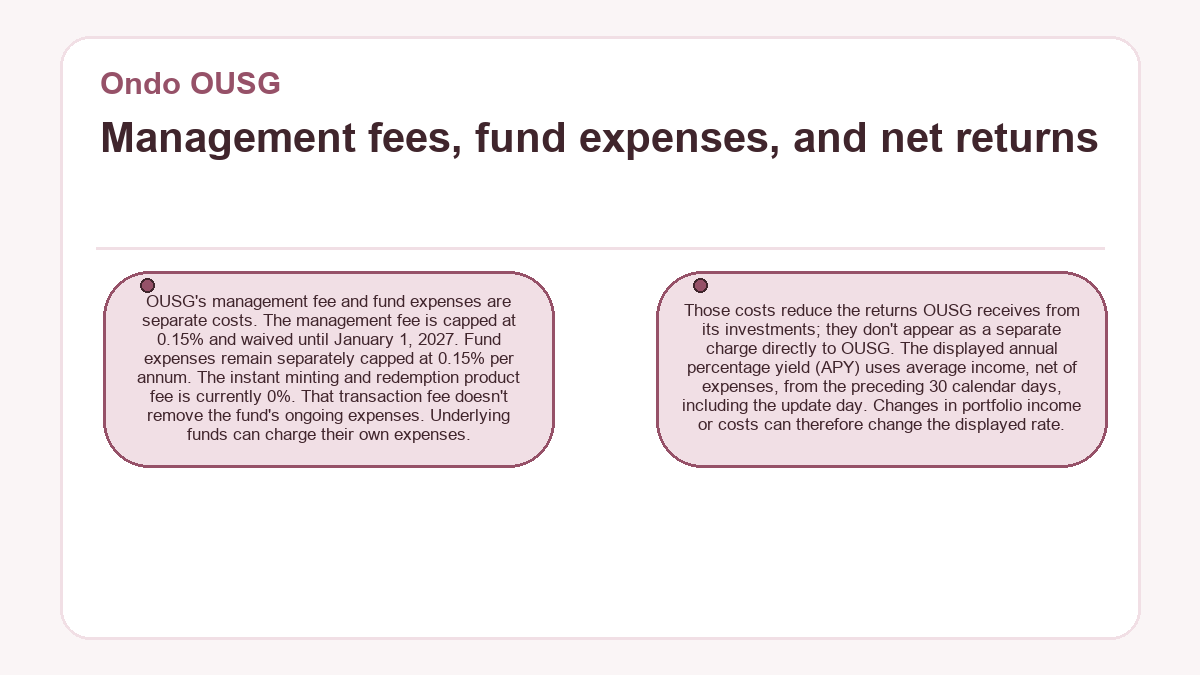
Underlying funds can charge their own expenses. Those costs reduce the returns OUSG receives from its investments; they don't appear as a separate charge directly to OUSG. The displayed annual percentage yield (APY) uses average income, net of expenses, from the preceding 30 calendar days, including the update day. Changes in portfolio income or costs can therefore change the displayed rate.
Fund ownership and the value of the exit
OUSG tokens represent unitized limited partnership interests in Ondo I LP. The fund invests in Treasury-related products and money market funds, and holds liquidity assets including USDC and bank deposits. Net income increases the net asset value (NAV) attributable to existing tokens. The redemption amount consequently depends on the token quantity and applicable NAV, alongside the route's costs and conditions.
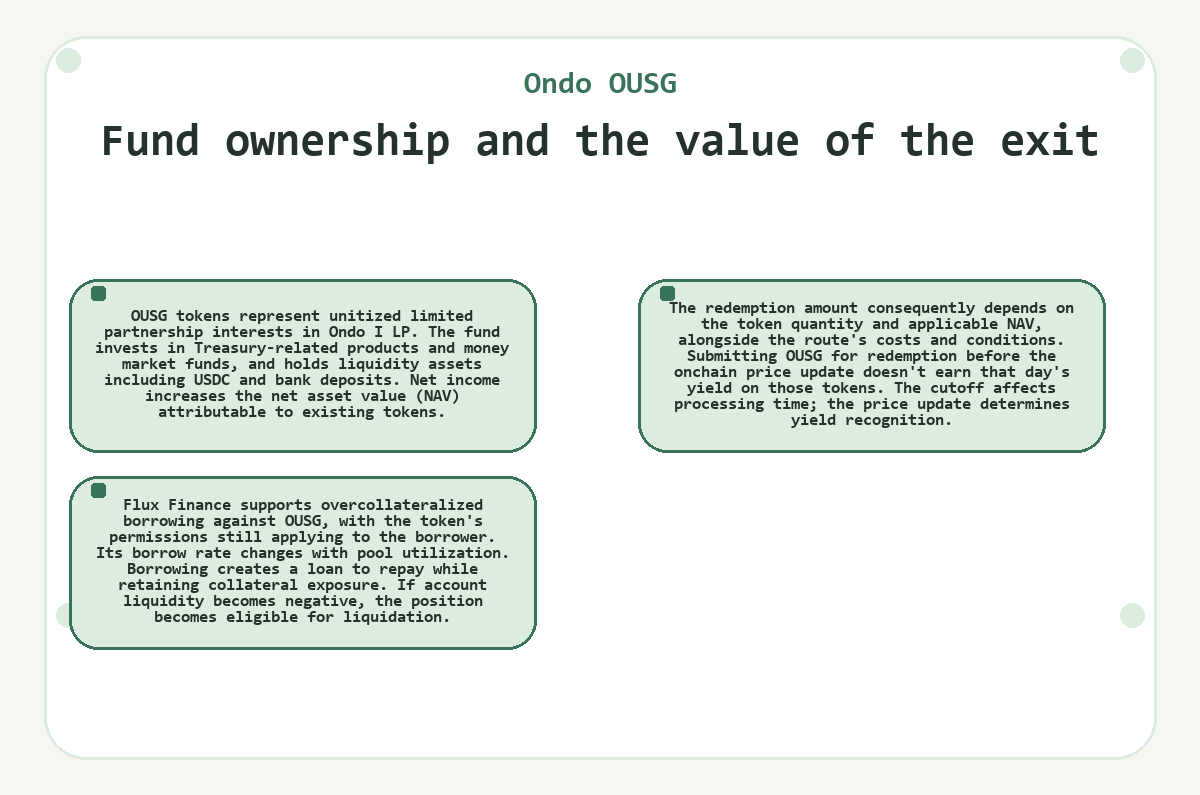
Submitting OUSG for redemption before the onchain price update doesn't earn that day's yield on those tokens. The cutoff affects processing time; the price update determines yield recognition.
Flux Finance supports overcollateralized borrowing against OUSG, with the token's permissions still applying to the borrower. Its borrow rate changes with pool utilization. Borrowing creates a loan to repay while retaining collateral exposure. If account liquidity becomes negative, the position becomes eligible for liquidation.
Popular questions about Ondo OUSG
Can U.S. investors qualify to hold OUSG?
Eligible U.S. individuals and organizations can hold OUSG after completing Qualified-Access Funds onboarding. They must satisfy both accredited investor and qualified purchaser requirements. Sanctions screening and jurisdictional restrictions still apply. The non-U.S. offering restrictions that govern USDY don't establish the access rules for OUSG.
Does a professional securities credential satisfy OUSG's investor requirements?
Certain professional credentials can satisfy the accredited investor part of OUSG eligibility. Recognized routes include Series 7, Series 65, and Series 82 credentials held in good standing. A credential doesn't replace the separate qualified purchaser criteria or fund onboarding. Applicants must provide evidence for the accredited investor route they select.
Will OUSG issue a tax form for the fund interest?
The OUSG fund issues Schedule K-1 forms to its limited partners. For U.S. federal income tax purposes, it operates as a partnership and passes income, losses, and other tax items through to partners. Each form details the partner's share of fund activity. Withholding can apply in specific circumstances, including certain foreign-partner and backup-withholding cases.
How does an OUSG transfer affect that day's yield?
The holder at the onchain OUSG price update receives that update's yield. A transfer completed earlier changes the eligible holder, provided the recipient still holds the tokens when the update occurs. The fund aims to update NAV each business day between 4 and 6 p.m. ET, although manual processing can take longer.
Are smaller non-instant OUSG test redemptions available?
An initial small non-instant test redemption may be possible by arrangement with Ondo. The standard non-instant redemption minimum is $50 000, and the test provision calls for contacting support. It doesn't establish a lower general minimum. Instant redemptions retain their separate $5 000 minimum and capacity limits.
On which networks can approved investors hold OUSG?
OUSG supports Ethereum, Polygon, Solana, and the XRP Ledger (XRPL). Its network availability leaves the fund's access requirements in place. Investors still need Qualified-Access Funds onboarding to receive or transfer the token; using a supported blockchain doesn't replace investor approval.
Is a custodial exchange account compatible with OUSG?
OUSG's supported wallet setup excludes custodial exchange accounts. Supported types include non-custodial externally owned accounts and multisignature wallets; Fireblocks wallets are also supported. Investors using bank wires for funding or withdrawals also provide wallet information. Wallet compatibility and fund eligibility are separate requirements, so an approved investor still needs a supported wallet.